Ambuja Cements is committed to meeting its tax responsibilities by ensuring full compliance with applicable tax laws across all jurisdictions in which it operates. The Company’s tax governance framework is structured to uphold transparency, accountability, and adherence to statutory obligations, while supporting value creation for shareholders and enabling sustainable business growth.
Taxes constitute a fundamental source of revenue for the Governments and play a vital role in financing development initiatives and socio-economic programmes. Accordingly, taxation provides a meaningful opportunity for businesses to demonstrate their equitable contributions to nation-building, supporting society, public services, infrastructure, economic advancement and social welfare.
Tax is regarded as a material and strategic matter that plays a significant role in enabling economic and social contributions and advancing the achievement of sustainable development goals.
This commitment is aligned with the Company’s aspiration to become a global leader in businesses that enhance lives and support nations in developing infrastructure through the creation of long-term sustainable value. Ambuja Cements believes that companies are obligated to comply with prevailing tax legislation, and Management recognises its responsibility to stakeholders to address expectations of transparent and responsible tax practices.
The Company is committed to upholding its tax responsibilities diligently in all jurisdictions where it conducts business. The Company’s approach to taxation and governance is structured to support such objectives, with the goal of consistently fulfilling its tax obligations promptly, in alignment with value creation and adhering to the applicable laws in each jurisdiction in which it operates.
As one of the foremost contributors to the exchequer, the Company acknowledges its responsibility to operate with integrity and accountability. The Company is guided by the principle of creating sustainable value for all stakeholders over the long term while reinforcing its commitment to transparency, fostering trust among stakeholders and supporting the development of a more accountable and responsible global tax framework.
All taxes and related compliance reports are filed within statutory due dates. The Company's operational framework comprises an annual compliance calendar that tracks/monitors statutory due dates. The Company strives to remain fully compliant with applicable tax legislation in the regions and geographies where it operates. It upholds a robust system of checks and balances (preparer-reviewer-approver) to ensure timely and accurate compliance with all statutory obligations. The Company seeks expertise from tax advisors wherever necessary and monitors its tax compliance in real time. The Company fulfils its obligation to pay a fair share of taxes in the jurisdictions where it generates value.
The Company provides detailed disclosures on tax practices, payments, and governance framework, going beyond statutory requirements to promote trust and transparency with its key stakeholders, including government, regulators and investors. The Company views appropriate disclosures and reporting as an opportunity to engage with key stakeholders.
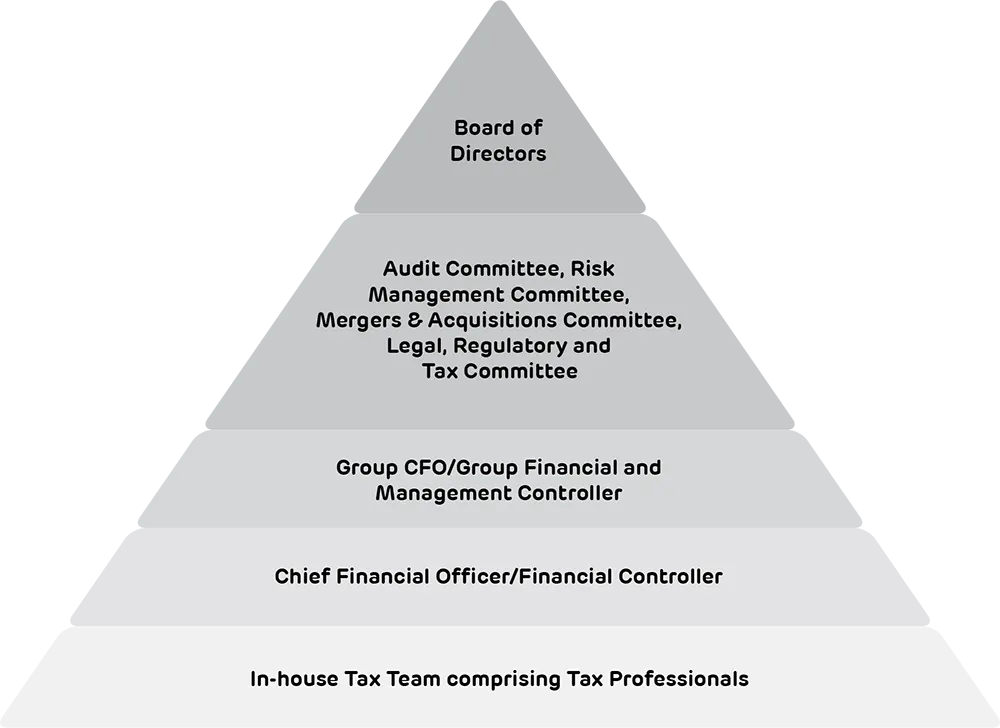
The Company's Board of Directors, along with the dedicated Tax team, oversees tax governance, closely engaging with the business units. The Company has established standard operating procedures and internal controls to handle tax-related matters, adhering to best practices and regulatory requirements. The Company's taxation policies are designed to consider long-term implications and ensure that the policies support both economic and social goals.
The Company's tax team collaborates with governments and industry bodies through participatory dialogues to help shape and influence tax policies while ensuring compliance with emerging regulations. The Company is dedicated to interacting with all stakeholders in a manner grounded in integrity and transparency, guided by its defined tax principles. As the Company adapts to the changing global tax environment, it prioritises meaningful stakeholder engagement, forward-looking advocacy, and organisational responsiveness.
The Company follows sustainable tax practices with high governance. It identifies tax risks from the perspective that they may be avoided/ mitigated. The Company's tax governance framework focuses on how tax risks are identified, managed, monitored and mitigated. Wherever significant positions are taken, the Company seeks advice from external experts/senior counsels. The key positions adopted are appropriately documented along with the basis for the same.
Standard operating procedures are built for tax processes, with the objective of following uniform and standardised procedures. Material tax matters are reported to the committee/sub-committee of the Board of Directors, as considered appropriate. Additionally, the Company has established the necessary vigil mechanism for employees and directors to report concerns about unethical or improper activities or any irregularities.
The Company's Board of Directors, along with the dedicated Tax team, oversees tax governance, closely engaging with the business units. It has established standard operating procedures and internal controls to handle tax-related matters, adhering to best practices and regulatory requirements. The Company's taxation policies are designed to consider long-term implications and ensure that the policies support both economic and social goals.


The Board periodically reviews all strategic tax matters in its meetings. Comprehensive due diligence is carried out for Mergers and Acquisitions, to effectively manage risks and ensure certainty.
Continuous tracking and monitoring of changes in tax legislation and policies
Engage external tax expertise to get clarity on the tax laws, where needed
Regular review of controls and governance practices to prevent non-compliances
Examine industry peers' tax approach to manage tax risks
Ambuja Cements contributed ₹17,130 crore in tax payments across direct, indirect and other contribution categories in FY2025-26.
Indirect Contribution
Direct Contribution
Other Contribution
Global tax and Other Contributions
Ambuja Cements has engaged professional consultants to provide an independent assurance report on the global contributions to the exchequer. The basis for preparation and the Company's approach to tax can be accessed through the following link:
Click Here