Culture of Risk Resilience
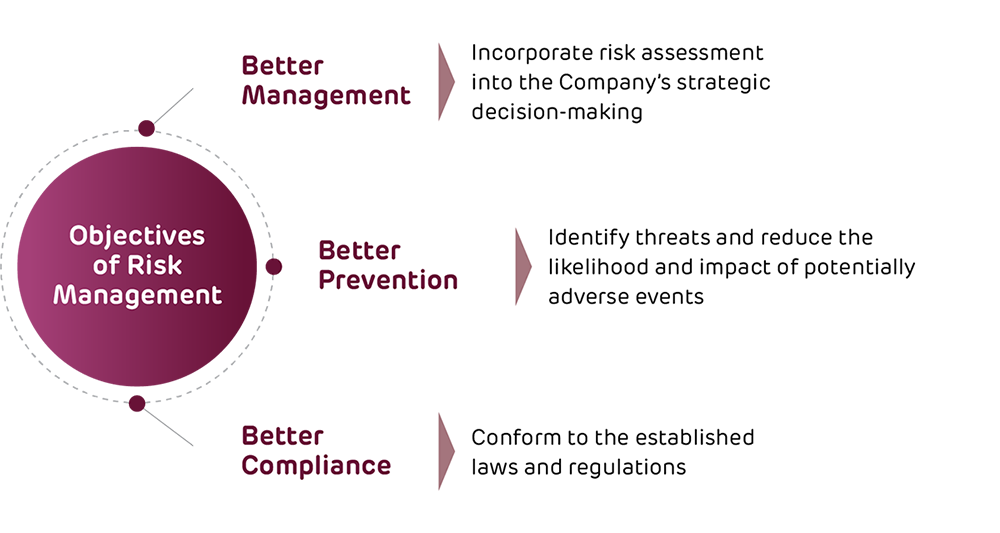
Ambuja Cements has established a strong Enterprise Risk Management (ERM) framework to proactively identify, assess and mitigate risks that may affect its operations, performance and longterm growth. This approach ensures preparedness against both internal and external challenges while enabling informed strategic decision-making.
Ambuja Cements’ focus has remained on building a strong enterprise risk management and governance framework. It is centred around strengthening communication with transparency, undertaking independent third-party assessments, and engaging consistently with its stakeholders.
Risk Management Process
The Company follows a systematic methodology involving comprehensive risk mapping, environmental scanning and detailed assessments. The Company embraces a risk ‘aware’ culture where it formally practices a standard framework, speaks the same risk language and is proactive and well ahead of the curve, in terms of identifying and treating risks effectively. Each function contributes by evaluating current and emerging risks, identifying potential opportunities and feeding into a consolidated, organisation-wide risk profile.
Targeted mitigation strategies are developed to address critical risks, supported by close monitoring from senior management. Strong internal controls ensure continued compliance, operational efficiency, and resilience across business processes.
Risk Management Framework
Adhering to the Adani Group’s risk management framework, Ambuja Cements follows a structured ERM framework that ensures consistent identification, prioritisation, mitigation, monitoring and reporting of key risks. With the support of key stakeholders, risks are proactively identified, evaluated and mitigated.
Risk Identification
and Assessment
Objective
Identify and evaluate potential risks that could affect operations and business objectives.
Actions
- Systematic scanning of internal and external environments
- Engaging key stakeholders to identify current and emerging risks
- Categorising risks based on severity and likelihood using a risk matrix
Tools
Environmental scanning, risk workshops, and SWOT analysis.
Risk Prioritisation
and Mitigation
Planning
Objective
Prioritise identified risks and formulate mitigation strategies.
Actions
- Rank risks based on potential business impact
- Develop targeted mitigation strategies, including avoidance, reduction, transfer, or acceptance of risks
- Define clear risk owners and action plans
Tools
Risk heat maps, response matrix, and action plans.
Risk Monitoring
and Control
Objective
Continuously monitor risks and ensure effective implementation of mitigation actions.
Actions
- Regularly track and assess risk indicators and mitigation progress
- Monitor internal and external changes to reassess risks periodically
- Report risk status to senior management and stakeholders
Tools
Risk dashboards, Key Risk Indicators (KRIs), and management reviews.
Communication
and Continuous
Improvement
Objective
Foster a risk-aware culture and continuously improve the risk management process.
Actions
- Promote risk awareness and communication across all levels of the organisation
- Regularly review risk management outcomes and refine strategies based on lessons learned
- Encourage cross-functional collaboration to enhance risk resilience
Tools
Training programmes, feedback loops, and post-implementation reviews.
Risk Governance
Ambuja Cements follows a proactive and structured approach to risk governance, ensuring alignment with the Company’s defined risk appetite and tolerance levels. A rigorous and consistent risk assessment process enables the organisation to identify, evaluate and mitigate both internal and external risks while maintaining regulatory compliance and operational efficiency.
Risk governance is embedded into strategic decision-making, supported by data-driven insights and periodic reviews. Quarterly risk updates are presented to the Risk Management Committee, chaired by senior leadership including the CEO and CFO, ensuring strong oversight, transparency and accountability. By applying both top-down and bottomup mechanisms, the Company consolidates risk intelligence into a comprehensive organisation-wide perspective. Focused monitoring of critical risks drives timely action and supports Ambuja Cements’ commitment to sustainable growth and business resilience.
Risk Management Committee (RMC)
Ambuja Cements’ robust ERM framework is overseen by the Risk Management Committee, consisting of 75% Independent Directors, in accordance with the SEBI Listing Regulations. Reporting directly to the Board, the RMC reviews governance structures, risk policies, assessment methodologies and mitigation progress to ensure an effective risk management ecosystem.

Commodity Price Risk Committee
Identifies and manages risks arising from commodity price volatility and updates the Commodity Price Risk Management (CPRM) in line with market dynamics.
Reputation Risk Committee
Reviews the Company's reputation and ethical standards, ensuring prompt escalation of concerns relating to reputational threats or conflicts of interest.
Legal, Regulatory & Tax Committee
Reviews legal, regulatory, and tax matters, and oversees compliance programmes to ensure adherence to statutory obligations.
Mergers & Acquisitions Committee
Assists in evaluating strategic proposals including mergers, acquisitions, divestments, and investments, and ensures adherence to due diligence processes.
Risks Identified for FY 2025-26
Definition
The Indian cement market is evolving rapidly, with consolidations and ongoing capacity additions increasing competitive pressure on market share and profitability.
Mitigating Factors
To mitigate this risk, Ambuja Cements is focusing on capacity expansion, thereby strengthening its market position across India. In addition, the Company is enhancing its brand equity through innovation and digitalisation to remain competitive and profitable.
Material Topics Impacted
- E6 Sustainable Construction
- S6 Customer Relationship Management
- G1 Corporate Governance and Business Ethics
- G2 Sustainable Supply Chain
Definition
Regulatory requirements are evolving rapidly across countries in response to climate and environmental concerns. Non-compliance with these new standards introduces significant complexity, with potential reputational and financial consequences. Addressing these challenges necessitates transformation, which entails upgrading and modifying strategies, which can often involve substantial costs.
Mitigating Factors
The Company is investing in various initiatives across its operations to lower carbon emissions and comply with the new emission standards for dust, SOx and NOx, as mandated by the Ministry of Environment, Forest and Climate Change (MoEF&CC). These initiatives help ensure compliance with environmental regulations and minimise any adverse impact.
Material Topics Impacted
- E1 Climate & Energy
- E2 Air Quality
- E3 Water Management
- E5 Biodiversity
- G1 Corporate Governance and Business Ethics
Definition
The cement industry is capital-intensive and heavily reliant on energy and resources (like limestone, fly ash and coal), which constitute a significant portion of operating costs. Consequently, effective cost management and efficiency improvements are critical to the industry's sustainability and competitiveness.
Mitigating Factors
Ambuja Cements prioritises long-term supply agreements to ensure business continuity by optimising its fuel mix, enhancing plant efficiency, and increasing the use of alternative fuels such as WHRS and solar energy, while also ensuring reliable fly ash availability through long-term sourcing agreements.
Material Topics Impacted
- E1 Climate and Energy
- E4 Circular Economy
- E6 Sustainable Construction
- G2 Sustainable Supply Chain
Definition
Cybersecurity is of utmost importance within the organisation. Ambuja Cements continuously identifies and mitigates potential data leakages that could threaten its information systems. Simultaneously, measures are being implemented to establish a secure and monitored environment for the use of AI tools and solutions. As the digital landscape evolves nationally and globally, Ambuja Cements recognises the need for the construction sector to adapt, driving the development of more efficient and effective solutions.
Mitigating Factors
Ambuja Cements operates within a secure environment, supported by advanced cybersecurity solutions and air-gapped, cyber-safe backup procedures to protect critical systems. Regular upgrades, patching, policy reviews and user awareness programmes strengthen resilience across networks, cloud infrastructure, data centres, business applications and cybersecurity frameworks.
Material Topics Impacted
- S6 Customer Relationship Management
- G2 Sustainable Supply Chain
- G3 Information Technology and Data Privacy
Definition
Health and safety are fundamental to how Ambuja Cements operates, requiring a multidisciplinary, collaborative approach, with a strong commitment from all stakeholders across every level of the organisation.
Mitigating Factors
Ambuja Cements continuously reviews systems and processes to enhance frontline safety. Initiatives such as 'Unchaai Kendra' and Life-saving Safety Rules raise awareness and help prevent accidents, while regular risk assessments further support onsite and offsite measures in Ambuja Cements's commitment to achieving 'Zero Harm'.
Material Topics Impacted
- S3 Human Rights
- S4 Occupational Health & Safety
- G2 Sustainable Supply Chain
- G1 Corporate Governance and Business Ethics
Definition
The main ESG Risks fall under the category of climate risk, water risk and biodiversity risk. Climate risks consists of physical risks (acute: flooding, droughts, etc; chronic: heat stress, water stress, etc.) and transitional risks (regulatory, technology, market, and reputation risks) which may impact operations and supply chains. The water stress in certain areas may impact water availability for operations as well as communities around. The dependencies and impact of our operations on the surrounding ecosystems may cause biodiversity risks.
Mitigating Factors
A strong climate governance mechanism is in place, supported by clear metrics, resilient infrastructure planning, emergency preparedness, and continuous monitoring aligned with climate targets, water efficiency and conservation initiatives and biodiversity conservation and enhancement.
Material Topics Impacted
- E1 Climate & Energy
- E3 Water Management
- E4 Circular Economy
- E5 Biodiversity
- E6 Sustainable Construction
- G1 Corporate Governance and Business Ethics
- G2 Sustainable Supply Chain
Definition
The cement industry is heavily reliant on natural resources such as limestone and coal. Ensuring a continuous supply of these essential materials, while maintaining optimal cost and quality standards, is critical for smooth business operations.
Mitigating Factors
To mitigate risks associated with natural resources, Ambuja Cements is enhancing operational efficiency to optimise resource utilisation. The Company is also prioritising resource conservation, reuse and recycling, implementing initiatives to improve the clinker factor and thermal substitution rate, alongside investments in renewable energy and WHRS systems to reduce reliance on non-renewable sources. Additionally, Ambuja Cements is investing in coal and limestone mines to secure the supply of key raw materials, aiming to enhance sustainability, minimise environmental impact and build a more resilient supply chain.
Material Topics Impacted
- E1 Climate & Energy
- E3 Water Management
- E4 Circular Economy
- E5 Biodiversity
- G2 Sustainable Supply Chain
Definition
Energy security is critical for Ambuja Cements, as it directly affects both operations and overall production costs. With energy expenses constituting a significant portion of production costs, particularly during the energy-intensive kilning and grinding processes, efficient management of energy consumption is essential for the Company.
Mitigating Factors
Recognising the significance of mitigating the risks associated with energy price inflation, Ambuja Cements implements a strategy to diversify fuel sources, including deploying alternative fuels. This approach minimises the impact of fluctuating energy prices and supports sustainability. The Company continually evaluates energy procurement options and implements innovative technologies to improve energy efficiency and operational resilience, ensuring it remains competitive in a dynamic cement industry.
Material Topics Impacted
- E1 Climate & Energy
- E4 Circular Economy
- E6 Sustainable Construction
- G2 Sustainable Supply Chain
Definition
Project execution is central to the Company's vision of achieving 119 MTPA by FY 2026-27, with large-scale projects already underway at multiple sites. Ensuring timely completion, upholding the highest safety and quality standards, and adhering to budgetary targets remain Ambujas Cements' foremost priorities.
Mitigating Factors
The Company leverages synergies with the Adani Group's project management arm to execute large-scale projects efficiently. Strong cash flow through internal accruals and an EPC-led project delivery model with global suppliers and streamlined processes under the Projects team's 5S approach help achieve maximum efficiency, speed and scale.
Material Topics Impacted
- E2 Air Quality
- E3 Water Management
- E5 Biodiversity
- S4 Occupational Health & Safety
- S5 Community Relations
- G1 Corporate Governance and Business Ethics
- G2 Sustainable Supply Chain
The comprehensive assessment of risks across market dynamics, regulatory shifts, natural resource security, cybersecurity, climate exposure, energy volatility and project execution also reveals significant strategic opportunities. Capacity expansion and consolidation under the One Cement Platform strengthen scale advantages, logistics optimisation and market leadership. Regulatory and climate imperatives accelerate innovation in blended cements, renewable energy integration, alternative fuels and circular economy practices, enhancing ESG differentiation. Resource and energy security challenges encourage investments in captive assets, green power and Waste Heat Recovery Systems, improving cost stability and long-term resilience. Digital and cybersecurity considerations are driving advanced analytics, IoTenabled manufacturing and stronger governance frameworks, unlocking productivity and operational agility. Together, these responses transform risk management into a catalyst for efficiency, innovation, competitive advantage and sustained stakeholder value creation.


